Story 1: Child Prostitutes are Children First-- A look into child prostitution and the controversial proposal to legalize prostitution to protect girls young and old.
Story 2: Reports of Widespread Violence in Zimbabwe-- As Mugabe desperately attempts to maintain his rule, intimidation violence spreads.
Story 3: Southern Africa Urges Small-Scale Farming-- To help combat rising food costs around the globe, small-scale farming has been recommended. (Anyone but me thinking Square Foot Gardening?)
Story 4: A Fresh Approach to Street Children-- A look into what Burkina Faso is doing for her children on the streets
Saturday, May 10, 2008


They Have Arrived!
Our first group of volunteers has begun their three-and-a-half-week journey in Ghana! The group of eight volunteers arrived earlier this week, and have been getting oriented to Ghana, visiting a few sites, and dropping off several suitcases worth of donations to Lucky Hill Orphanage on their way out of Accra! Jessica, our group coordinator, has been in the country for an extra week preparing for their arrival.
The girls will be at Sankofa on Monday to begin teaching. Jessica will be at New Life, teaching and giving the square foot gardening a boost! More information will be coming soon as the girls begin their volunteering. We wish them all the best of luck!
The girls will be at Sankofa on Monday to begin teaching. Jessica will be at New Life, teaching and giving the square foot gardening a boost! More information will be coming soon as the girls begin their volunteering. We wish them all the best of luck!
Sunday, April 27, 2008
Cape Coast-- A Small Sampling
Our first group to Ghana leaves a week from tomorrow! We are excited to hear how their trip will go. In the meantime, I'll post an exerpt from the book I'm writing. Perhaps our volunteers will become a part of this very scene.
I became a common fixture there as well, a part of the pulsing mobs. After taking a taxi from my house to town, I “dropped” at Kotokuraba and found whoever was proclaiming “Jukwa!” that day. I always took a moment to buy “pure water” from one of the ladies or girls. Though it came in a plastic sachet like “ice water,” pure water was purified, its bag carefully sealed in a bloated square, and stamped with blue ink. I stuffed a few in my dirtier-by-the-day backpack and climbed aboard the tro tro. Somewhere between two and thirty minutes later, the tro pulled out—they only left when they were full. The ride took me through Cape Coast and into the suburb of Adisadel, then past Pedu Junction and to Abura, the suburb where my host’s sister, Mama Joyce, lived. After Abura came scattered jungle, a secluded hotel on a small crocodile pond called Hans Cottage, past the barren earth where women crushed rocks under small thatched shelters, and on to the tiny hamlet of Ansapatu—just short of the larger village of Efutu.
I called to the mate, the young boy who took passenger’s money, and the tro tro stopped. People in the aisle seats stood to fold their seats up and step out so I could crouch past, then piled back in again and headed on up to the town of Jukwa. I turned to Ansapatu, which consisted of a few small houses, a tiny shop, a school, and New Life International Orphanage. Smiling and waving at the women who sat among the enormous pile of greenish-yellow oranges they were selling, I headed down the red dirt hill, anxious to get to my children.
The orphanage was across the little lane from the orange and brown government junior secondary school (JSS), set nearly at the edge of the rainforest. It was painted a bland white with blue trim, and an unfinished three-room schoolhouse hunched next to it. A small orange tree stood near the front gate to the left, a palm tree further down. The refuse pile and laundry lines sat away from the school, near the large, overgrown area referred to as the garden. The cement basins where the children bathed were farther away, near the bushes where the “bathroom” was—a large pit crossed with wooden beams. A rickety wooden fence made a pitiful attempt to keep the goats out of the garden, and a painted sign declared it to be “New Life International Orphanage Home/School for orphaned, abandoned, and needy children.”"
"I close my eyes, sometimes, when I’m alone, and call up pictures in my mind of my favorite places in Ghana. Kotokuraba market. I see a flurry of color and motion, of heat and noise. Set in the center triangle created by three crossing streets, it is a place of commerce, confusion, and commotion. Taxis, tro tros, and a few private cars crowd the streets around it. Both taxis and tro tros, or small vans, function as mini buses, with people crammed in with their goods and the occasional goat. Across from the market is the “station,” where I would take a tro tro every day to the orphanage. Dozens of little VW vans crowded the area, all painted to proclaim the driver’s belief in Jesus. “The Lord will provide,” or “Gye Nyame”—except for God. Apparently, this proclaimed belief precluded a need for seatbelts. The drivers stood near their tros, calling out their destination. “Takoradi, Takoradi,” and “Jukwa Jukwa Jukwa Jukwa Jukwa!” Women and children wandered around, adding their own voices, like that of so many birds, proclaiming the wares atop their heads—water, bread, cookies. “Aeeees water,” “paaaanoo,” and “beeescuits!” One man marched through the area daily, holding an umbrella over his head that dangled with handkerchiefs of numerous colors and designs. Set in a large circle, surrounded by shops and flocking with hawkers, and only one way in or out, the station became a joyful place for me.
I became a common fixture there as well, a part of the pulsing mobs. After taking a taxi from my house to town, I “dropped” at Kotokuraba and found whoever was proclaiming “Jukwa!” that day. I always took a moment to buy “pure water” from one of the ladies or girls. Though it came in a plastic sachet like “ice water,” pure water was purified, its bag carefully sealed in a bloated square, and stamped with blue ink. I stuffed a few in my dirtier-by-the-day backpack and climbed aboard the tro tro. Somewhere between two and thirty minutes later, the tro pulled out—they only left when they were full. The ride took me through Cape Coast and into the suburb of Adisadel, then past Pedu Junction and to Abura, the suburb where my host’s sister, Mama Joyce, lived. After Abura came scattered jungle, a secluded hotel on a small crocodile pond called Hans Cottage, past the barren earth where women crushed rocks under small thatched shelters, and on to the tiny hamlet of Ansapatu—just short of the larger village of Efutu.
I called to the mate, the young boy who took passenger’s money, and the tro tro stopped. People in the aisle seats stood to fold their seats up and step out so I could crouch past, then piled back in again and headed on up to the town of Jukwa. I turned to Ansapatu, which consisted of a few small houses, a tiny shop, a school, and New Life International Orphanage. Smiling and waving at the women who sat among the enormous pile of greenish-yellow oranges they were selling, I headed down the red dirt hill, anxious to get to my children.
The orphanage was across the little lane from the orange and brown government junior secondary school (JSS), set nearly at the edge of the rainforest. It was painted a bland white with blue trim, and an unfinished three-room schoolhouse hunched next to it. A small orange tree stood near the front gate to the left, a palm tree further down. The refuse pile and laundry lines sat away from the school, near the large, overgrown area referred to as the garden. The cement basins where the children bathed were farther away, near the bushes where the “bathroom” was—a large pit crossed with wooden beams. A rickety wooden fence made a pitiful attempt to keep the goats out of the garden, and a painted sign declared it to be “New Life International Orphanage Home/School for orphaned, abandoned, and needy children.”"
Copyright Shallee M. 2008
Saturday, April 12, 2008
News from the Continent #2
Here's a few stories from the African continent!
The first story is a rather uplifting one about Child's Rights International setting up schools that encourage not only learning, but establish a platform for children to express their own views.
The next story discusses the progress (really, it is some progress!) in the Kenyan government.
This one is also from Kenya, discussing an outreach program for street children.
The last story focuses on children in Zimbabwe who are receiving free surgery to correct cleft lips and palates.
What with Zimbabwe's and Cameroon's failing democratic situations, Joseph Kony's failure to sign the peace deal in Uganda, and the general disheartening stories often found in African news, I decided to focus on some more positive stories today. If you want the rest, check out www.allafrica.com.
Thursday, March 27, 2008
Issues Affecting African Children #5: In Ghana, Water is Life
It's been a while since the last IAAC post...the closer our teams get to leaving for Ghana, the more busy things become! We can't wait to get back to the children at New Life, and to help them and others!


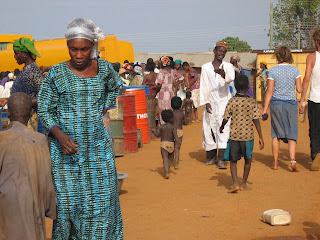
Today's post is about something I take for granted more than anything else: water. It's so easy in the west to simply turn on a tap and drink straight from it. In Ghana, I had to get used to drinking only purified water-- not too much of a trial. When I was at New Life, they did not yet have running water, though it came while I was there. For the first few months, water was hauled every day from wells by the children. It was not entirely clean, and one of the children had an ulcer on his leg from it. That was the first time I really thought about water beyond something to drink, wash with, and play in. It was life.
Then I traveled to the hot, arid north. In the village of Larabanga, as I was being shown the village, I saw a deep wash-- completely dry-- covered in deep holes. We descended into it, and I discovered that in the rainy season, it was a large pond. Now, in the dry season, it was a dust bowl. Many of the men in the village went out every day to dig and dig until they managed to get a few feet of filthy water. Water was something I had never even thought of as a necessity-- it was just there. Suddenly, I was facing an entire village so desperate for every drop, they spent their days to gain such a meager bucket of muddy water. And they were grateful for it.
While I was there, I happened to see one of the sporadic arrivals of a government water truck. The village went mad. They brought barrels, buckets, anything that could hold water and formed a mob around the truck, desperate for the absolute necessity they were deprived of. A well was in the process of being built for the village, but for the moment, that water truck and the muddy water from the wash were all they had. Water was life-- and lack of it was death.
As the article linked above mentions, even in the metropolis of Accra, water is sometimes hard to come by. Damaged water works are a big problem, and many days, people went without running water. Lack of water for farmers means drought, and therefore less food. This increases prices of goods, upping inflation, a big problem in Ghana at the moment. Water is the absolute basis of life, it affects so many things, and yet so many people live without it. Here are a few places you can go to help: http://www.idrinkbecauseicare.blogspot.com/ and http://www.waterwellsforafrica.com/.
The Return
The directors are back, and the trip was a great success! All of the legal processes were completed to begin the school, and construction should be starting any day now! The directors were also lucky enough to meet Mr. Kingsley Eshun, who has started an orphanage near the Buduburam Refugee Camp. Luckyhill Children's Home was begun in 2001, and serves around 80 children, plus 300 that come to school! Mr. Kingsley has done amazing work, much of it with his own hands, to provide all that he can for the children there. They are still in need of much support, though they are getting help from several different avenues. We have hopes that we can continue our work with Mr. Kingsley and Luckhill!
Tuesday, March 11, 2008
And They're Off!
FFCI's directors, Katherine and Blaine, are now in Ghana! After the scare with Blaine's health prior to their January trip, we weren't sure if they'd be able to make it, but they are now in Ghana and starting our school! I can't wait to see it (even partially finished) when we go over this summer.
In addition, I'd like to wish a belated Happy Independence Day to Ghana! March 6th was Ghana's 51st independence day, and to celebrate, the volunteers heading over this summer had a little party. Just a little fried plantain, Fanta, high life music, and a prep for Ghanaian culture, but it was fun!
We also have heard from one of our contacts that we will (most likely) be receiving a donation of 200 children's literacy books! This is very exciting for us-- we are building a school, after all!
I'll post more once the directors return on the developments-- and it's past time for another IAAC post. It's a busy time around here, but I'll get to it!
In the meantime, here's a pic to enjoy, since I haven't posted one in a while!

This is Prince, one of the students from my class at New Life in 05. He came into school from the village halfway through the school year. He spoke no English (though he liberally made up for it by chattering in Fante all through class), and it was a challenge just to get him to trace a line. However, he slowly improved (especially in school manners!) and was a playful, happy student and child. One of his favorite things was to "sew" cardboard pictures with string and hear me try to help him in Fante. "Ha? [Here?]" he would ask, pointing to a little hole in the cardboard. "Oho, ha [No, here]," I would respond, indicating the right hole. He would laugh in delight every time, occasionally calling to his classmates, "Bruni, wotse Fante! [The white lady is speaking Fante!]"
Subscribe to:
Posts (Atom)

 Posts


