Thursday, June 10, 2010

You Can Promote Literacy in Africa-- AND Win Prizes!

Over at Reach for the Stars, we're holding a raffle to raise money for 5 kids from New Life to go to high school! For as little as $5 bucks and spreading the word, you can get up to five entries for some amazing handmade Ghanaian prizes. So what's the story?

When I was 20, I ditched college and took off for Africa. I thought it would be the adventure of a lifetime, and it was. But it ended up being so much more than that. For four months, I taught the children at New Life International Orphanage and learned more about patience and love than I had in the last twenty years of my life combined. I made friends and learned to live in a different world. Most importantly, I realized that it was real life for the people in Ghana-- not the amazing adventure I'd come for.When I was 20, I ditched college and took off for Africa.

One particular boy I got close to was Michael. On my last day in Ghana, he quietly asked me as we walked down the dusty road if I would remember him. I have never forgotten him; I have prayed for him, sent letters to him, and visited him again in 2008. And now I have the chance to do more-- help him continue his education. In Ghana, high school isn't compulsory, and it isn't free. Michael and four of his friends have passed their exams to go, they just don't have the money to get there.

Here's the cool thing: you can help-- and you can have a chance to get some really cool Ghanaian stuff in the process.

Please help Michael and these other kids that I know and love raise the money they need to break out of their poverty!

Tuesday, February 23, 2010

New Life and Sankofa Updates!

Here are some updates from Amanda, who's doing some work with both Sankofa and New Life! (She previously volunteered at New Life.)

"I've talked to David and he sounds like such an amazing person. I'm so excited to be able to help out with the things he wants because he has such distinct plans for what he wants the school to become and how he is going to do it, he just needs the means. To begin he says he wants to do a full-scale farm with chickens, goats, cows, really randomly ducks, and all sorts of veggies to help pay the teachers salaries and feed the kids so we're gonna finance that. People in the village have also offered there land because they're so grateful for everything he's done. Sarah [Frank] says shes working with BlueKitabu to set up an internet cafe as well but I'm very removed from that so don't have any other deets on it.

"For New Life Derrick says he wants a technology center so we applied to Computer Aid for 10 computers. I actually think we have a really good shot of getting them and then we can add all sorts of educational games for them that I really hope they actually use. Do you remember John and Nicholas? They want to put him into an apprenticeship so he can learn a trade and then there are 5 children going into high school who will need help funding and lots of others in the coming years going so we'll help fund that too. I'm positive we'll have enough money for that and then depending on how much the farm costs (David hasn't gotten back with an estimate yet) I'm pretty sure we'll have enough money to sponsor Gloria to go to university or whatever education she would like after high school. Depending on how much we can save in the future I'm hoping we can sponsor other kids for university too.

"I am so excited for the opportunity to be able to work with David. His ability to make something from absolutely nothing is awe inspiring and I feel like with just a little bit of help he can do so much for the kids."

Saturday, February 6, 2010

Impressions of Ghana #3: Cities, Structures, and Villages

Again, it's been a while! I'm so busy right now I'm afraid blogging just doesn't happen much. I don't have many new updates, just that things are going well at New Life, and Sankofa is still in need of help and donations. Hopefully, a former New Life volunteer who is doing an internship in Senegal will be able to help a bit at Sankofa soon! I'll post details when I know more. So in the meantime, how about an "Impressions of Ghana" post!

When I first went to Ghana, I had a friend ask if I had thought they all lived in trees. I hadn't, but I also hadn't pictured the things I saw. Like most Westerners, I saw Ghana as rural villages with grass-leaf huts. While there are places that look like that, there's a lot more to Ghana!
This is the Independence Arch in Accra. It's a symbol of their independence, with the country's motto "Freedom and Justice" and the year "AD 1957" emblazoned on it. The black star is a symbol of African freedom (even their soccer team is called the Black Stars).
Traffic in Accra is comparable to traffic in any big city. It's loud, noisy, and crowded! Accra is a big city in every sense of the word.
This is a main intersection in Cape Coast, with the crab monument in the center (the crab is a symbol for Cape Coast's booming fishing trade). Lined with houses, shops, and small stands, it is often crowded with cars and pedestrians fighting for space, as there are few, if any, sidewalks in Ghana. Cape Coast has the feel of a still large but more urban city.
Not all streets in Ghana's cities are paved-- many side streets, even in larger cities like Cape Coast, are packed dirt. In smaller cities, there may not be any paved streets at all.

Some villages in Ghana are very unique-- take Nzulezo stilt village, for example. The village is built over a lake in the Amansuri wetlands, and the only way to get there from the town of Beyin is by canoe. The town has it's own "main street" (a main wooden walkway through the town), and it's residents live quite normal lives, cooking, fishing, working, going to school, and going about their lives just as anyone else might.
There are many shops in Ghana lining the streets. This one, outside Kumasi in 2005, was one of my favorites. If you look closely, you will see that this artist/sign painter chose to depict Osama bin Laden, George Bush, and Sadaam Hussein. Look even closer, and you will see the two Middle Eastern dictators looking quite pleasant, while George Bush looks rather fierce. I found this incredibly amusing.
There are, of course, those mud huts featured so prominently in Western movies and television. In the north of Ghana, these homes often have flat roofs to allow for drying grains or other things on the roof in the hot sun. You may notice a wire leading from a stick through the home's wall-- it has electricity.
This village, near Nkoranza in more central Ghana, is also a common Westerner view of Ghana. Mud huts, again, but with thatched palm or corrugated tin roofs rather than flat ones.
Here is a view of a portion of Cape Coast. Here, houses are built primarily of concrete, which weathers the climate of Ghana quite well. Apartment buildings and individual homes may often be more similar to Western homes than many expect-- they have tile floors, televisions, and furniture often reminiscent of something in your own home.
Here is another example of Ghanaian culture-- Elmina Slave Fort. These "castles" dot the coastline of Ghana, and were used in older days as forts for the various colonizers and ports for shipping out slaves. Many are now museums dedicated to remembering this tragic past with a promise never to repeat it.
Religious buildings, such as this beautiful mosque, are common in Ghana. Christian churches and Muslim mosques often stand near each other, particularly in the south (the north is primarily Muslim). Religious tolerance in Ghana is quite high.

Here is an example of a Christian church in Accra. The temple of the Church of Jesus Christ of Latter-day Saints is a beautiful representation of the strong Christian presence in the south of Ghana.

Thursday, October 15, 2009

I'm Alive! And here are some updates...

Sorry for the long silence! What with the last trimester of pregnancy and being a new mom, I've had a lot on my plate! I'm enjoying being a mother, and now have a little time to do some updates, and maybe some more Issues and Impressions posts in the near future.

You'll notice that New Life has a new webpage! It's the same address, but the site has been completely revamped and looks great! Check it out if you get the chance. Also, two volunteers, Lanaya and Mason, traveled to Ghana last month! Mason has since returned home, but Lanaya is still volunteering. She spent some time at Sankofa, and is now enjoying working at New Life.

On the volunteer note, 15-year-old Emma and her mother are hoping to travel to Ghana this December! They are going to be working with David at Sankofa, and are trying hard to raise money for the trip and for the school. On the school note, David has managed to get some donations, and the school building has been started! We're so happy about this, and grateful to those who have helped in any way! Here are a few pictures!
David with one of the children.

The new school is finally going up!

Wednesday, June 10, 2009

Updates from the Orphanages

Boy. It's been a while. Here's a bit on the news front:

New Life
The kids at New Life are doing well. Currently, Zoe, a former volunteer, has returned and is enjoying her time with the children. We're hoping for more updates on her return!

Sankofa
Sankofa is not doing so well at the moment. David is struggling even to be able to pay the teachers, who have now gone on strike. Several of us are looking into strategies to help with management of the school and orphanage. In good news, David states that enough donations came through to put in a foundation for a permanent school building, and the parents in the village are eager to contribute to the labor. Of course, more funding is needed to finish buying the materials. If you would like to contribute to the building effort, or (more importantly at the moment) to the teacher's fund, please visit www.chworldwide.org.

Lucky Hill
On the adoption front at Lucky Hill, things are going very well! Many children have been able to join their families, including Comfort, a special young lady with heart problems. After successful surgery, she is now recovering in the arms of her family. We wish the best to all the children at Lucky Hill, and pray for those still waiting to join their families! See Lucky Hill's Yahoo group for more information.

Families for Children
Work on the school building and hostel for Families for Children is going slow. The hope is to get the hostel built first. Once completed, it will provide a place for volunteers to stay, as well as any travelers, local or foreign. It will also hopefully provide revenue for the school, as well as vocational training to the older students, making the program sustainable. If you would like to make a contribution to this effort please contact Shallee for information on making a tax-deductible donation.

Saturday, March 28, 2009

A Look Back at June's Volunteer Trip to Sankofa

For a few more pictures and stories from our June 2008 volunteer trip to Sankofa Children's Home and School in Ghana, please go here! (I'm afraid I was too lazy to repost all those pictures again on this blog...) These are some new pictures taken by several of the volunteers, with the stories that go with them!

Friday, March 20, 2009

On the Importance of Education in Rural Africa

I apologize for the lack of recent posts. I'm happy to say, it's due to good news on my part-- I'm pregnant! Now that I have crossed the second trimester threshold and have a little energy, I'll hopefully be a bit more diligent about posting.

Today, I'd like to give you a message from Derrick Gaisie, director of New Life International Orphanage, on the importance of education. It's a little long, but an excellent look at rural education from an insiders point of view. If you would like to donate to help New Life continue to provide for students in rural areas, please go here!


Derrick (center in orange) with New Life's teachers: (L to R) unknown, Frank, Olivia, Elizabeth, Derrick, Theophilus, Evelyn, Aisha, Mr. Arthur, and Jackie

"Growing up poor in isolated rural areas and small towns is qualitatively different from growing up poor in the cities. Yet most of what experts know about the effects of poverty on children’s development comes from studies conducted in big cities. The development of every child in the early days of its childhood is understood to be foundational for later cognitive and social development and early success in school. However, knowledge of relations among cognitive and social-emotional aspects of self-development in childhood and the relation of child characteristics and early experience to developing self-regulation is quite limited.


Poverty is associated with stress and increased risk for poor child outcomes in the transition to school. Poverty is likely to disrupt family processes that are critical for establishing early childhood competencies associated both with cognitive and socio-emotional development and success in school. Children living in rural areas do not have access to quality educational structures like tables, chairs, or conducive classroom blocks for teaching and learning which in the long run affects how best a child grasps knowledge impacted to them by the rural teachers.


Particularly important in this project is the measurement of the quality of childcare/ Head Start experiences from birth through school age through actual observation of the care setting in the rural homes, the observation and transcription of book reading experiences in the home by both mothers and fathers, and the observation of the quality of instruction in the elementary school classroom as children make the transition to formal schooling. The above issues are very much critical to the children under review and under the care of New Life International [which is located in a rural area]. About 70 per cent of the poor live in rural areas.


Ghana is located on the west coast of Africa and the central region is a coastal stretch of land from the boarders of Accra being the capital to the demarcation separating central region from the western region. About 70 percent of people make a living from the primary industry, mainly agriculture; and education is an essential prerequisite for reducing poverty, improving agriculture and the living conditions of rural people and building a food-secure environment. Education is a basic right in itself. In spite of this, children's access to quality education in rural areas is still much lower than in urban areas, adult illiteracy is much higher and the quality of education is poorer. Expanding access to quality education for rural people is thus of crucial importance in the realization of human rights for all and in achieving the Millennium Development Goals (MDGs).


New Life International as a non-profit, non-sectarian and non-governmental but charitable organization has planted its self in the middle of a rural certain in Cape Coast, central region of Ghana to offer quality education to children who are orphans, vulnerable and needs protection/Training, and to serve as an educational hub in that location (Ansapatu Village near Cape Coast). It is an educational hub in the sense that children in that locality find it extremely difficult to read, understand and pass their exams and this has become a problem for all rural children. NLI has been able to build three classroom blocks which is currently serving as a school for primary education KG 1-2, Nursery and primary 1-6 for less fortunate children (orphans, vulnerable and needy children) in the community. There has been a lot of changes in Ghana’s educational policy and gradually improving. The facilities that we have now are not the best but needs immediate improvement.


The size of our 3 classroom blocks are becoming smaller and the number of children admitted into the school is growing everyday. At the moment we are running 3 class groups in one room. The congestion and the instance where one class group will have to read aloud whiles the other class needs concentration to learn and etc are our fundamental problem.This phenomenon has brought about the need to separate all classes from each other. Kindergarten 1, 2, nursery and class 1 are run in one classroom block. Classes 2, 3, 4 in another classroom and 5 and 6 are also in another room.


Again, Ghana Education Service, the oversight authority of Ghana’s education in the district has given some recommendations of change and as a result, New Life International should and must construct 9 classroom block so that we can separate the classes to enhance teaching and learning. Secondly, as part of the new educational policy in Ghana, every school must have what we call “ICT center” where some amount of computers are wired and functional for the children to use as part of their core subject(computer studies) when they write their ninth grade exams nationwide. (JHS EXAMS) These computers would help the children and the surrounding communities to learn computer studies and enhance their knowledge in computer technology as the world is now globalized. This is educational policy.


The statistics that is characterized by school drop out in the area between the ages of 13 and 17 are very much alarming and this happens before attaining the age of 20.They end up becoming “child farmer” and or “child labourer” on building construction sites in the community. This trend has been the case for years and new life international over the years (10yrs) has been the center trying to change this phenomenon. There are schools in the community but their outputs are nothing to write home about. Yes they exist. We want to establish our junior High School block so that we can give the children a proper education when it comes to teaching and learning. This will benefit the whole community.


Many children come to school as composites of the broken pieces in their lives: divorce, homelessness, learning disabilities, and from homes in which they must become self-sufficient at an early age. Some must deal with crime, suffer abuse and neglect from adults; or become parents while still children themselves. These problems must be addressed comprehensively to deliver needed services. As the founder of NLI has said, "We cannot take just one fragment of a child's life and make a difference.We have to look at the whole of a child's life." When all necessary systems work together, change can happen. Our services has always to give children under care the needed support in the area of education (school), shelter, food, healthcare, social and moral discipline for them to able to face the challenges our times and to contribute their quota the development of Ghana.The government has done its best to give free education by introducing what we call “capitation grant” and school feeding programmes for some selected schools in the country but large numbers of the rural schools are facing problem of “access to quality education.”


NLI has been the bridge to close the “educational gap” between the rural and urban schools specifically Ansapatu village, Cape Coast and its surrounding villages and towns in central region of Ghana. NLI admits needy, vulnerable and orphan children into our “children center” give them everything that a child would need. NLI currently cares for two categories of children namely: resident and non-resident. There are kids who reside in the children’s center and virtually live completely in the “home” ages between 11 months to 18 yrs while other children come from within the communities, attend free school and leave. Residents in the children center numbers up 45. Total children under review are 198. We will want to build 9 classroom blocks which would be used for teaching and learning. Two of the classrooms would be used for computer center and library and the rest for academic work (JHS or junior High School) inclusive). New Life Preparatory School is serving the children of the community who have been identified or brought to the center for support, but the larger picture is to ensure that the whole area benefits from the quality of education we offer. We need your support!"

-Derrick Fletcher Gaisie
Director, New Life International Orphanage and
New Life Preparatory School
Ghana

Saturday, January 24, 2009

Obies at Sankofa!

Sarah, who we've mentioned here before as a volunteer at Sankofa, has returned with a group of Oberlin students to Sankofa! They lived in Eguafo for the last month and just returned home. They were able to work with David to get a great deal of administrative things done to help the school and home. If you would like to read more about the fantastic job they did, please visit their blog!

Saturday, January 17, 2009

Classroom Chaos-- A Day in the Life of an Orphanage Volunteer Teacher in Ghana

I walked into the classroom at New Life with great trepidation. A tremendous noise was coming from that room, and I dreaded what I would see.

I saw children, children everywhere. Classes 1, KG1, KG2, and Nursery were all held in this room. That meant 50 children ages 2 to 7 in one room. If you've never seen that many kids of that age together, you wouldn't believe the noise that can be made.
I wanted my verandah back.

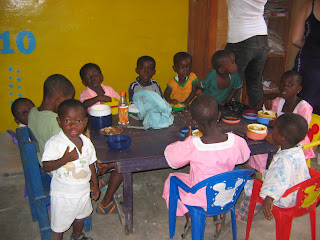
Some of the Nursery class eating lunch, 2008

In 2005, I had taught the nursery class at the orphanage on a verandah because there were no classrooms. Back then, Nursery had consisted of ten kids between 2 and 7 years old. Though it wasn't a real classroom, it was at least our very own. I didn't know how I was possibly going to teach the fifteen or so children that now made up nursery in a room this noisy. Not to mention the fact that nursery now really meant nursery-- none of the kids in the class were older than 4.


Shallee on the verandah with the nursery class, 2005
Catherine waved me over to the bouncing, chatting nursery corner. We would be teaching together, which I was happy for. Not only would we be able to help each other, but I was happy to have finally met Catherine, whom I'd only had email contact with previously. The teaching began. It consisted of us shouting out colors, numbers, and stories, trading places when our voices got tired. Coloring was my favorite part of the day because it didn't require me to yell, but I did eventually lose my voice for about a week.

Alice, left, and her friends color in nursery, 2008

And yet, hard as it was, I was happy to be back at New Life teaching. Though I was only there every other day because of my responsibilities at Sankofa, I loved being back in this familiar place. I loved looking across the room and seeing Benjie and Adjoa, who had been in my original nursery class, busily writing in their books in class 1, knowing I had had at least a small hand in helping them get there. I loved talking with the kids in my new class in Fante, trying to help them understand the very basics of education. I loved playing with the children at breaktime, and watching them on the new playground equipment. I loved getting to know Catherine, my fellow teacher.
Shallee on the playground with some of New Life's children, 2008

But I definitely did not love that classroom. It severely limited the learning potential of all the children-- there were just too many of them in one room. New Life is now trying to build an additional classroom onto the school building, hoping to separate the classes so they can actually hear their teachers speak. If you would like to donate to this project, please head over to Catherine's website, Children's Helpers Worldwide, and make a donation to New Life's classroom fund!


Shallee and Catherine outside the classroom with some of the children, 2008

Saturday, December 20, 2008

Meet Michael of Sankofa

As I tumbled out of a taxi onto the street of Eguafo, Ghana for a day of teaching at Sankofa, I felt tired. Maybe part of it was that the whole cram-six-people-into-Kojo's-taxi-for-an-hour stint was getting a little old; I love my husband, but sitting half on his lap and half on the metal wire sticking out of the taxi seat was not my idea of quality couple time. Glancing back at the other volunteers extracting themselves from the car, I could tell they were a little sick of it too.

After paying Kojo, we all began to troup down the street toward the trail that would lead us into the village and thence to school. While kicking up orange dust and shouldering my backpack, I was hissed at by a man nearby. Don't worry; hissing is simply a way of getting attention in Ghana. I once saw a Ghanaian man do it at the New York airport. He got pretty frustrated when the airline attendant didn't seem to pay any attention to his obvious efforts to get help.

But I digress. I turned my head to the hissing man, who held the hand of a tiny, chubby-faced child. He spoke to me in Fante, then tried to pass the child's hand to me. I looked at him blankly until he managed to say, "School. You take."

I smiled and nodded, reaching for the little fingers. They were yanked away and I was given a glower all the more impressive considering the giver was maybe three years old. I tried to comfort him by saying, "Bra. Yeko skool." (Come on, let's go to school.) Giving a half-angry, half-fearful squawk, he shrank against his guardian's legs. When I squatted down and held out my hand again, the little man bravely stepped forward, waved a hand at me, and declared loudly, "Ko!"

I began to laugh. He was telling me in no uncertain terms to go away and I couldn't help but admire his tenacity. His guardian shrugged and grinned, taking the little hand again and following us to school.
That wasn't the last time I saw Michael, as I learned he was called. His cheerful, determined little demeanor was very endearing and he became my favorite of the younger children. My husband also came to enjoy the little one. Here he is playing with Michael, in the red and white, before the PTA meeting.


It seems I am destined to love little boys named Michael. I have a little one at each orphanage now, though New Life's Michael is grown to a young man of 14 and doing well in junior high school. Sankofa's little Michael still has many years ahead of him. Please donate to save Sankofa today, and help Michael to be a young man who goes on to get a good education.


Tuesday, December 9, 2008

Donate to Save Sankofa School!

The future for the children at Sankofa has become uncertain, and we need your help!

Unless Sankofa can build an actual school building, school board officials will shut down the school and the children of Eguafo will have few chances for lifting themselves out of poverty.
Currently, classes at Sankofa are held under rudimentary bamboo roofs that offer little protection from the elements. However, the children are out of the streets and gaining knowledge, the only thing that promises to give them a future. Without Sankofa, most of these children cannot afford to go to the government school nearby, and they will return to spending their days on the streets or working a farm.

Several volunteers are working with an organization called Children’s Helpers Worldwide to raise money to save Sankofa. If you can help me by donating, you can help preserve the future for these children I have come to love. Our goal is to raise $5,000 for the building and materials as soon as we can! Even if you can only part with a few dollars, it can help! If you find you cannot, please help me by letting as many of your friends and contacts know as you can and encouraging them to donate.

To donate using a credit or debit card through PayPal, please go to http://www.chworldwide.org and click Donate. Please indicate that it is for Sankofa. PayPal donations can be securely made even if you don’t have a PayPal account. Information on paying by check is there as well.

If you are an American and wish to donate by check, please send an email to familiesforchildren[at]gmail[dot]com for more information. Because Children’s Helpers Worldwide is a British organization, checks cannot be sent there from the U.S. Unfortunately, this means tax deductions in the U.S. are also unavailable. For more information about Sankofa, please visit www.sankofachildrenshome.org, or view our video and other posts below. Please email any questions to the address above.

Please donate soon to help save Sankofa and provide a future for the children of Eguafo!

Tuesday, December 2, 2008

Impressions of Ghana #2: The African Family


Just a few from the family, Efutu village, 2005
In the Western world, our families tend to be small and focused on the nuclear family. In Ghana, families are larger, and extended family members are close. In fact, cousins are often referred to as brothers or sisters, which can cause confusion for us obrunis. Large families often live together in one compound, with adults from several generations in one household. Here is Michael (far right, back) from New Life. His mother Grace is next to him, and her brother is next to her. Grace is a widow, and her brother helps care for the family. The other children here were introduced to me as Michael's "brothers."
Best Friends and Brothers, 2005
Here is Michael again, on the left, with his brother Amos. They are actual biological brothers. Amos lives at the orphanage, while Michael lives at home with his mother. A sad fact of Ghanaian life is that not all parents can afford to feed and care for all of their children. Many times, some of the children of a family are sent to live with better-off relatives, or to live at orphanages.
Hard Workin' Mamas, 2005
It is not uncommon to see women working with their babies on their backs. Babysitters are an unheardof concept in Ghana, and mothers can't afford not to work. Often, if the family is very poor, the children must stay out of school to work the farms, or hawk things in the street to help the family survive.

Playtime for Mother and Daughter, 2005
Here, my host mother Mama Vic plays a hand-clap game with her daughter Nana Esi. Whether gripped by poverty or not, families still find time to play together in Ghana. This can be through simple games, songs, or stories.

Brothers by Love, 2005
Here, Frank and Abraham show their brotherly love at New Life International Orphanage. They are not biologically related at all, but the bonds forged through love are often as strong as those made by blood. The children in the orphanages may be there because they have no families, but they often find a family in each other.


Saturday, November 29, 2008

Second Ghana Movie- Sankofa!

Watch Hope for the Future, our short video about Sankofa!


Thursday, November 27, 2008

We're Moving!

Prayers from Africa was set up initially for New Life International Orphanage. Now that we're reporting from multiple orphanages, it's time for a little change! Starting on November 29, we will be moving to http://prayersfromafrica.blogspot.com/. Come see us there!

Wednesday, November 26, 2008

News from the Continent #4

Education moving forward in Liberia

No more excuses for gender violence

Paracetamol kills 25 children

One million children get life-saving mosquito nets

Check out these articles for more information. As always, www.allafrica.com has the latest news from across the continent.

Tuesday, November 25, 2008

Learning to Lead

When I asked my husband in August of 2007 if he'd go to Ghana with me if we arranged a group of us to go, I had no idea what I was getting into.

I had been to Ghana. I had sent three other volunteers to Ghana. I had been working on the advisory board of a non-profit organization for two years. I had minored in African studies and read voraciously anything on Africa, development, and non-profits I could get my hands on. I knew what I was doing, right?

Yeah, right.

Ready to leave Accra for Cape Coast.

For nearly a year after that, I found out exactly how much I didn't know. From recruiting the volunteers to holding monthly meetings to fundraising to flights to arranging for us to volunteer in a brand new orphanage I'd never been to...it was insane. There was so much stress involved in arranging for 14 people to travel to and volunteer in a foreign country, much that I hadn't anticipated. Luckily, I had a lot of help from my dear hubby, as well as Jessica, a girl I'd previously sent to Ghana who agreed to be the coordinator for one of the groups.
Hanging with the monkeys at Boabeng Fiema Monkey Forest.

It wasn't til we left that I really started to feel the weight of what I was doing.

I had been to Ghana, yes. But I had been alone. I was all I had to worry about until I got over myself and started worrying for and loving the New Life kids more. This time, it was different. I was mama duck to five little ducklings who were in a whole new world. Yes, they'd had training, but nothing prepares you for the real thing. The weight of responsibility was incredible, especially considering we were hosted in three separate locations. We were in a third world country, and I had taken responsibility for their well-being, health, and to see that we accomplished our volunteering goals. Were they getting enough water? Did they know the way to the bank? Did they know how to catch a taxi and then go back home? Were they getting overwhelmed with culture shock and homesickness? Were they getting overwhelmed with the responsibilities of teaching? Did they feel like they were doing enough work, or had too much? I was constantly focused on making sure they were taken care of, and it was so much more taxing than I ever would have thought.

Saying goodbye to Green Turtle Lodge.

And yet, they were wonderful. They were responsible. They all quickly rose to the occasion, worked with the slight chaos and unstability that is a third world country, and came out on top. They learned to take taxis on their own. They learned their way around town. I eventually felt comfortable enough to take every other day to go to New Life, trusting that they knew what they were doing. Even then, though, I was constantly focused on making sure they were doing okay. I had carefully planned how I wanted things to go in Ghana before I left-- the things I wanted to get done while there. Almost none of it happened. Yet, in the end, that was okay.

Teaching them how to read.

Because we still got great work done. A few kids learned their ABC's. Some learned that letters have sounds. Still others learned that sounds could be pieced together to make words. And six people who left the USA as practically strangers returned as friends, teachers, and people changed for the better. In some ways, it was so much harder than my first trip, yet I am so grateful I had the chance to lead those people out there, and to learn a bit more myself.

Last day at Sankofa with David and a few of the teachers and kids.

Saturday, October 11, 2008

Issues Affecting African Children #6: Aid Issues in Africa

Jane, Felicia, Sara, and a friend.

The first time I met Sara, she did an uncharacteristic thing-- shetried to keep me from being cheated. I was buying bofroot, a fried ball of dough, from her mother.

"Thousand cedis," Jane declared. I raised an eyebrow, but before I could open my mouth to say I knew it was half that, Sara leaped up from the stoop where she'd been sitting.

"No, no!" she exclaimed. "She is trying to cheat you! It is 500!"

Jane laughed, and I paid the 500. It was actually the start of a wonderful friendship with her and her daughters Sara and little Felicia.

The difference in price, for me, was about five cents. I could have just bought it at the higher price and dealt with it, but I refused to be knowingly cheated simply because I was an obruni. Jane was a good woman, and had nothing personal against me, but because I was white, she supposed two things: 1) I had more than enough money to spare, and 2) I probably didn't know the right price anyway.

Such is the attitude of many Ghanaians toward foreigners and their money. In a way, it's our own fault. For decades, the Western idea of aid was to walk in to a country and fling about cash like confetti. Here, we cried, feed your children, build your homes, go to school! And sometimes it worked that way. Much of the time, governments whisked it off into the anonymity of off-shore bank accounts. When it did reach the people, some began to develop the idea that foreigners equal money-- and they just love giving it away! That idea has become ingrained in many psyche's across the nation.

I had a friend email me a few weeks back. He had been asked to leave school because he couldn't pay his tuition. He begged me to send money so he could return to school. A conundrum was born. It was his education-- possibly the most important investment of his entire life, one that would save him from abject poverty. And yet, I myself am poor by American standards. My husband's own tuition was due, and there was barely enough to pay that. In addition, was I helping or hurting by simply handing out money whenever I was asked? Eventually, I had to tell him I couldn't send the money, but I suggested he try to find a temporary job to help him earn his tuition. This was a novel idea for him, and he thanked me almost as much for it as he would have for the money. It's strange that this idea had not occured to him; but really, was it all that strange considering the ideas he grew up with? White people = money, and he knew a white person! His problems would be solved.
Of course, there are some who do not have this attitude. Sara, with her determination that I not be cheated. My friend Dawood, who my husband and I are voluntarily helping through university. The only thing he ever asked for was for help buying a computer; not for us to buy it for him, but for him to send us the money he had earned so we could purchase it in the U.S. where used computers are cheaper.
Africans are a strong people, and their culture and society did fabulously well for centuries. They don't need us continuing to rule over them with aid as we did with colonialism. Of course, that area of the world is in desperate need of help. We should help others if we are able, if only because we all belong to the race of mankind. Many organizations are formed to give people an opportunity for just that. For one fabulous example in Africa, take a look at Care for Life. They focus on strengthening families and communities, helping people learn to rely on themselves and their community. And that is what aid should really be about.
**Disclaimer: This is not a slam against anyone or any organization that sends money to impoverished areas! There are some areas of the world that are simply too ravaged by poverty, war and disease to be able to become self-sufficient at the moment, and direct monetary aid is often, in those cases, the best and only course of action.

Tuesday, October 7, 2008

Elizabeth- A Virtuoso Pianist in the Making

One of the things I wanted to do on this most recent trip to Ghana was to teach the children to use the keyboard I knew another volunteer had left. I spoke with my old piano teacher, bought the beginner books she recommended, and had high hopes of eager and proficient students. I'm always an idealist.

Of course, things never work out the way you think they well-- especially in Ghana. It wasn't until my last day at New Life I actually managed to find time to pull out the books, bring in the batteries, and dig up the keyboard. I knew there wasn't much time, but maybe, I thought, I can at least teach them enough that they can use the books to teach themselves.

Most of the kids were either too busy or not interested to sit in on the lessons. Belinda, Elizabeth, and Ophelia were the most interested. I taught them about the different beats each note gets. We clapped through several sections, trying to get the timing right. To my surprise, Elizabeth could clap out each pattern almost flawlessly.

And that wasn't all. As I began to teach them which keys were which note, she began to zip through the songs that labeled each note. She wasn't actually reading the music, but she was able to read the labeled notes and remember exactly which ones were which on the keyboard. And she kept perfect time. Belinda and Ophelia did pretty good too, but whenever they got the timing or note wrong, Elizabeth immediately corrected them. I was astounded. She was a natural.


Belinda, Elizabeth, and Ophelia check out the next song in the book.

We played through some more songs, and I let them look at the part that began to explain the actual reading of music. Elizabeth was fascinated, and delighted with herself for being good at something naturally. We weren't able to get far, but far enough that Elizabeth at least would be able to follow the simple instructions in the book to continue learning. I don't know if she will, or if the others will either. There are many things they need to do with their time, but I hope Elizabeth and any others who desire are able to keep learning. If any volunteers go back who know how to play, see if you can pull out that keyboard, pull up the piano books I left, and give it a go!

Thursday, October 2, 2008

Videos from Sankofa

These videos from YouTube are from a dance and drum troup called FanFa Kids. They visited Sankofa this August!


Saturday, August 9, 2008

New Video-- The Return to New Life

There is a new video from this June's trip to Ghana! This one focuses on New Life; I'll be posting another in a few months on Sankofa. There were many wonderful things happening at New Life.