Thursday, June 10, 2010
You Can Promote Literacy in Africa-- AND Win Prizes!
Tuesday, February 23, 2010
New Life and Sankofa Updates!
"I've talked to David and he sounds like such an amazing person. I'm so excited to be able to help out with the things he wants because he has such distinct plans for what he wants the school to become and how he is going to do it, he just needs the means. To begin he says he wants to do a full-scale farm with chickens, goats, cows, really randomly ducks, and all sorts of veggies to help pay the teachers salaries and feed the kids so we're gonna finance that. People in the village have also offered there land because they're so grateful for everything he's done. Sarah [Frank] says shes working with BlueKitabu to set up an internet cafe as well but I'm very removed from that so don't have any other deets on it.
"For New Life Derrick says he wants a technology center so we applied to Computer Aid for 10 computers. I actually think we have a really good shot of getting them and then we can add all sorts of educational games for them that I really hope they actually use. Do you remember John and Nicholas? They want to put him into an apprenticeship so he can learn a trade and then there are 5 children going into high school who will need help funding and lots of others in the coming years going so we'll help fund that too. I'm positive we'll have enough money for that and then depending on how much the farm costs (David hasn't gotten back with an estimate yet) I'm pretty sure we'll have enough money to sponsor Gloria to go to university or whatever education she would like after high school. Depending on how much we can save in the future I'm hoping we can sponsor other kids for university too.
"I am so excited for the opportunity to be able to work with David. His ability to make something from absolutely nothing is awe inspiring and I feel like with just a little bit of help he can do so much for the kids."Saturday, February 6, 2010
Impressions of Ghana #3: Cities, Structures, and Villages
Thursday, October 15, 2009
I'm Alive! And here are some updates...
David with one of the children.
The new school is finally going up!
Wednesday, June 10, 2009
Updates from the Orphanages
New Life
The kids at New Life are doing well. Currently, Zoe, a former volunteer, has returned and is enjoying her time with the children. We're hoping for more updates on her return!
Sankofa
Sankofa is not doing so well at the moment. David is struggling even to be able to pay the teachers, who have now gone on strike. Several of us are looking into strategies to help with management of the school and orphanage. In good news, David states that enough donations came through to put in a foundation for a permanent school building, and the parents in the village are eager to contribute to the labor. Of course, more funding is needed to finish buying the materials. If you would like to contribute to the building effort, or (more importantly at the moment) to the teacher's fund, please visit www.chworldwide.org.
Lucky Hill
On the adoption front at Lucky Hill, things are going very well! Many children have been able to join their families, including Comfort, a special young lady with heart problems. After successful surgery, she is now recovering in the arms of her family. We wish the best to all the children at Lucky Hill, and pray for those still waiting to join their families! See Lucky Hill's Yahoo group for more information.
Families for Children
Work on the school building and hostel for Families for Children is going slow. The hope is to get the hostel built first. Once completed, it will provide a place for volunteers to stay, as well as any travelers, local or foreign. It will also hopefully provide revenue for the school, as well as vocational training to the older students, making the program sustainable. If you would like to make a contribution to this effort please contact Shallee for information on making a tax-deductible donation.
Friday, March 20, 2009
On the Importance of Education in Rural Africa
Today, I'd like to give you a message from Derrick Gaisie, director of New Life International Orphanage, on the importance of education. It's a little long, but an excellent look at rural education from an insiders point of view. If you would like to donate to help New Life continue to provide for students in rural areas, please go here!

Derrick (center in orange) with New Life's teachers: (L to R) unknown, Frank, Olivia, Elizabeth, Derrick, Theophilus, Evelyn, Aisha, Mr. Arthur, and Jackie
"Growing up poor in isolated rural areas and small towns is qualitatively different from growing up poor in the cities. Yet most of what experts know about the effects of poverty on children’s development comes from studies conducted in big cities. The development of every child in the early days of its childhood is understood to be foundational for later cognitive and social development and early success in school. However, knowledge of relations among cognitive and social-emotional aspects of self-development in childhood and the relation of child characteristics and early experience to developing self-regulation is quite limited.Poverty is associated with stress and increased risk for poor child outcomes in the transition to school. Poverty is likely to disrupt family processes that are critical for establishing early childhood competencies associated both with cognitive and socio-emotional development and success in school. Children living in rural areas do not have access to quality educational structures like tables, chairs, or conducive classroom blocks for teaching and learning which in the long run affects how best a child grasps knowledge impacted to them by the rural teachers.
Particularly important in this project is the measurement of the quality of childcare/ Head Start experiences from birth through school age through actual observation of the care setting in the rural homes, the observation and transcription of book reading experiences in the home by both mothers and fathers, and the observation of the quality of instruction in the elementary school classroom as children make the transition to formal schooling. The above issues are very much critical to the children under review and under the care of New Life International [which is located in a rural area]. About 70 per cent of the poor live in rural areas.
Ghana is located on the west coast of Africa and the central region is a coastal stretch of land from the boarders of Accra being the capital to the demarcation separating central region from the western region. About 70 percent of people make a living from the primary industry, mainly agriculture; and education is an essential prerequisite for reducing poverty, improving agriculture and the living conditions of rural people and building a food-secure environment. Education is a basic right in itself. In spite of this, children's access to quality education in rural areas is still much lower than in urban areas, adult illiteracy is much higher and the quality of education is poorer. Expanding access to quality education for rural people is thus of crucial importance in the realization of human rights for all and in achieving the Millennium Development Goals (MDGs).
New Life International as a non-profit, non-sectarian and non-governmental but charitable organization has planted its self in the middle of a rural certain in Cape Coast, central region of Ghana to offer quality education to children who are orphans, vulnerable and needs protection/Training, and to serve as an educational hub in that location (Ansapatu Village near Cape Coast). It is an educational hub in the sense that children in that locality find it extremely difficult to read, understand and pass their exams and this has become a problem for all rural children. NLI has been able to build three classroom blocks which is currently serving as a school for primary education KG 1-2, Nursery and primary 1-6 for less fortunate children (orphans, vulnerable and needy children) in the community. There has been a lot of changes in Ghana’s educational policy and gradually improving. The facilities that we have now are not the best but needs immediate improvement.
The size of our 3 classroom blocks are becoming smaller and the number of children admitted into the school is growing everyday. At the moment we are running 3 class groups in one room. The congestion and the instance where one class group will have to read aloud whiles the other class needs concentration to learn and etc are our fundamental problem.This phenomenon has brought about the need to separate all classes from each other. Kindergarten 1, 2, nursery and class 1 are run in one classroom block. Classes 2, 3, 4 in another classroom and 5 and 6 are also in another room.
Again, Ghana Education Service, the oversight authority of Ghana’s education in the district has given some recommendations of change and as a result, New Life International should and must construct 9 classroom block so that we can separate the classes to enhance teaching and learning. Secondly, as part of the new educational policy in Ghana, every school must have what we call “ICT center” where some amount of computers are wired and functional for the children to use as part of their core subject(computer studies) when they write their ninth grade exams nationwide. (JHS EXAMS) These computers would help the children and the surrounding communities to learn computer studies and enhance their knowledge in computer technology as the world is now globalized. This is educational policy.
The statistics that is characterized by school drop out in the area between the ages of 13 and 17 are very much alarming and this happens before attaining the age of 20.They end up becoming “child farmer” and or “child labourer” on building construction sites in the community. This trend has been the case for years and new life international over the years (10yrs) has been the center trying to change this phenomenon. There are schools in the community but their outputs are nothing to write home about. Yes they exist. We want to establish our junior High School block so that we can give the children a proper education when it comes to teaching and learning. This will benefit the whole community.
Many children come to school as composites of the broken pieces in their lives: divorce, homelessness, learning disabilities, and from homes in which they must become self-sufficient at an early age. Some must deal with crime, suffer abuse and neglect from adults; or become parents while still children themselves. These problems must be addressed comprehensively to deliver needed services. As the founder of NLI has said, "We cannot take just one fragment of a child's life and make a difference.We have to look at the whole of a child's life." When all necessary systems work together, change can happen. Our services has always to give children under care the needed support in the area of education (school), shelter, food, healthcare, social and moral discipline for them to able to face the challenges our times and to contribute their quota the development of Ghana.The government has done its best to give free education by introducing what we call “capitation grant” and school feeding programmes for some selected schools in the country but large numbers of the rural schools are facing problem of “access to quality education.”
NLI has been the bridge to close the “educational gap” between the rural and urban schools specifically Ansapatu village, Cape Coast and its surrounding villages and towns in central region of Ghana. NLI admits needy, vulnerable and orphan children into our “children center” give them everything that a child would need. NLI currently cares for two categories of children namely: resident and non-resident. There are kids who reside in the children’s center and virtually live completely in the “home” ages between 11 months to 18 yrs while other children come from within the communities, attend free school and leave. Residents in the children center numbers up 45. Total children under review are 198. We will want to build 9 classroom blocks which would be used for teaching and learning. Two of the classrooms would be used for computer center and library and the rest for academic work (JHS or junior High School) inclusive). New Life Preparatory School is serving the children of the community who have been identified or brought to the center for support, but the larger picture is to ensure that the whole area benefits from the quality of education we offer. We need your support!"
-Derrick Fletcher Gaisie
Director, New Life International Orphanage and
New Life Preparatory School
Ghana
Saturday, January 17, 2009
Classroom Chaos-- A Day in the Life of an Orphanage Volunteer Teacher in Ghana
In 2005, I had taught the nursery class at the orphanage on a verandah because there were no classrooms. Back then, Nursery had consisted of ten kids between 2 and 7 years old. Though it wasn't a real classroom, it was at least our very own. I didn't know how I was possibly going to teach the fifteen or so children that now made up nursery in a room this noisy. Not to mention the fact that nursery now really meant nursery-- none of the kids in the class were older than 4.
But I definitely did not love that classroom. It severely limited the learning potential of all the children-- there were just too many of them in one room. New Life is now trying to build an additional classroom onto the school building, hoping to separate the classes so they can actually hear their teachers speak. If you would like to donate to this project, please head over to Catherine's website, Children's Helpers Worldwide, and make a donation to New Life's classroom fund!
Shallee and Catherine outside the classroom with some of the children, 2008
Tuesday, October 7, 2008
Elizabeth- A Virtuoso Pianist in the Making
Of course, things never work out the way you think they well-- especially in Ghana. It wasn't until my last day at New Life I actually managed to find time to pull out the books, bring in the batteries, and dig up the keyboard. I knew there wasn't much time, but maybe, I thought, I can at least teach them enough that they can use the books to teach themselves.
And that wasn't all. As I began to teach them which keys were which note, she began to zip through the songs that labeled each note. She wasn't actually reading the music, but she was able to read the labeled notes and remember exactly which ones were which on the keyboard. And she kept perfect time. Belinda and Ophelia did pretty good too, but whenever they got the timing or note wrong, Elizabeth immediately corrected them. I was astounded. She was a natural.
Belinda, Elizabeth, and Ophelia check out the next song in the book.
We played through some more songs, and I let them look at the part that began to explain the actual reading of music. Elizabeth was fascinated, and delighted with herself for being good at something naturally. We weren't able to get far, but far enough that Elizabeth at least would be able to follow the simple instructions in the book to continue learning. I don't know if she will, or if the others will either. There are many things they need to do with their time, but I hope Elizabeth and any others who desire are able to keep learning. If any volunteers go back who know how to play, see if you can pull out that keyboard, pull up the piano books I left, and give it a go!
Saturday, August 9, 2008
New Video-- The Return to New Life
Monday, August 4, 2008
Worship and Assembly in Ghanaian Schools
In addition to RME, the students start and end each day with Assembly. They line up in their classes, say the Lord's Prayer, sing a song that is usually religious in nature, say the Pledge, and then march while singing to their classes. Closing assembly is much the same.
In many schools, a certain period one day a week is set aside for Worship. At New Life, this consists of singing, dancing, praying, reading from the Bible, and sometimes a competition to see who can best answer religious trivia. At Sankofa, the children gathered into the bamboo school house for a similar ceremony-- singing, praying, and telling of Bible stories.
Saturday, July 12, 2008
Impressions of Ghana #1: Sons and Daughters of Africa
I have no words for this picture; it speaks on its own. Larabanga, 2005.
This young man is emblematic of the throngs of people hawking their goods on the streets of Ghana. They are at the tro tro stations; the toll booths; the bus stops; they are everywhere they can possibly make a profit. Some are mere children, desperate to take home a few pesewas (pennies) for school fees, clothing, and food. Cape Coast, 2005.
Kente cloth is the beautiful, hand-woven fabric made throughout Ghana. Traditionally worn by chiefs, the fabric is woven in scarf-like strips that are then sewn together to make clothing. The weaving of the cloth is an intricate and complicated process. 2005.
Sons of the SeaAlong the coast of Ghana, fishing is an enormous part of the economy. Everyday, fisherman go out in their small boats, often using only sails, oars, and teamwork to cast their nets. These young men are hauling in a net full of fish. If only the still image could capture the harmony of the rhythmic chanting that helps them stay in sync. Cape Coast 2005
Traditional dance is yet another important part of Ghanaian heritage. Belinda at New Life is only one of the many children taught this beautiful part of their culture. 2005.
For many in Ghana, an education is something of which they can only dream. Madam Grace, former caregiver and headmistress of New Life, gave every part of herself to teach and care for the children there. 2005.
The markets in Ghana are throbbing centers of commerce. It is primarily women who work here, selling everything from fish to snails to fabric. These women work hard to provide for themselves and their families. Kejetia Market, Kumasi, 2005.
Daughters of Royalty
In Ghana, villages and cities are still headed in part by chiefs. However, the chief has a counterpart in Ghana that many don't know about-- the Queen Mother. She is not always the chief's mother, or even a relative, but she is there to help provide council and direction along with the chief. These women are dressed as a Queen Mother would be at a festival or celebration. Shama 2005.
Daughter of God
Religion is an incredible force in Ghana. Whether Christian, Muslim, Traditionalist, or other, Ghanaians are devout in their faith. At Christian schools, such as Sankofa, the children say the Lord's Prayer each morning and afternoon. Eguafo 2008.
Thursday, July 3, 2008
The Return to New Life International Orphanage
Three years, later, I was astounded as I walked down the hill to see the changes that had taken place. I had seen pictures since I left, but nothing can change your own mental image of a place except seeing it again in person. The school building is now complete, meaning there's more sleeping room in the home, there are mosquito nets for all the children, a store to earn money, an enormous farm, a playground, a dining area, a kitchen, toilets, and a new home being built so the children have more room to live and play. The buildings were painted pink and brown, and flowers housed in pots made of tires decorated the land in front of the home.
Of course, it was the children I really wanted to see. Danny and I had come late into the afternoon, and for a moment it seemed no one was around. Then Emmanuel came out of the house. My throat tightened as I hugged him for the first time in three years, and we both laughed. He told me all the older ones were working on the farm, behind the new house, and he would take me there. Then Ophelia came dashing out, her beautiful face glowing with a smile I remembered well. More laughing, hugging, crying, talking. She was taller.
The little ones came around as we headed to the farm, swarming me. With a start, I recognized one of the taller, chatty boys. "Benjie!" I cried. He grinned up at me, but I knew he didn't remember me. Though I taught him for four months, he had been only two and a half at the time. I hugged him anyway. There were many clustered around him that I didn't recognize-- new faces since three years ago. One girl, seven years old and small for her age, like they all were, giggled as the little ones started chanting my name: "Shallee, Shallee..." They pronounced it "Shelly," like always, and I had to smile as they dragged her over. "Shallee, Shallee!" they cried, pointing at her. Her name was Shallee, or "Shelly" too. Still giggly, but shy, she pulled away to the back of the crowd.
That day remains now in my memory as very sweet-- yet also a little bitter. For three years, I had held these children in my heart and called them mine. I held fiercely to the idea that they were my children. Coming back, I realized the truth. I love them, as many volunteers since my time have loved them. They have grown, and changed, and though I still love them and some of them still remember and perhaps love me, they are not mine. They belong not to me, but to each other and to their full-time caregivers. That is their family. That is their life. I came for a short time only, and though I have shared my heart and my hands, that did not make them as wholly mine as I had so long thought. My heart had to break a little that day in order to open up and let "my children" go. That was the bitterness. The sweetness was feeling the love I still hold for them, and being able to physically hold them in my arms again.
Friday, June 27, 2008
Return from Ghana-- Photos of New Life and Sankofa
Abigail, Monica, and Philomena at Sankofa.
Katie, a volunteer, learning to play Ampe at Sankofa.
Painting the orphanage at Sankofa.
Tuesday, June 17, 2008
Updates from Sankofa and New Life
The teachers at Sankofa are truly wonderful. They give up so much of their own time for very little pay to help these children who would otherwise have no education at all. Though they learn under a bamboo roof with a dirt floor, the key is that they are learning.
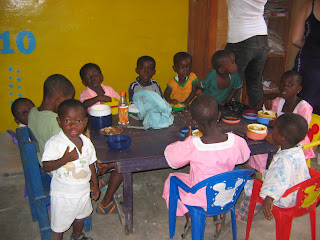
New Life has grown in leaps and bounds since my last trip three years ago! The new building is nearly complete, and a new classroom is being built for the nursery children. At the moment, nursery, KG (kindergarten) 1, and KG 2, and class 1 are all in the same classroom-- this is obviously chaotic. There is not enough room for the children to properly learn, and there is far too much noise. The new classroom is going up quickly, however! It's a joy to watch the children play on the playground and to see the progression of those who are now three years ahead of when I last taught them.
We will be coming home in a week, and what a trip it has been! Pictures and video will be up when I get some time after coming home, and I'll post snippets and stories about the children and volunteers as well!
Saturday, May 24, 2008
Good things Happening at Sankofa
Most of the girls are at Sankofa. They have been helping build an addition to the bamboo school house, as well as helping teach the children. There have done rotations with the 80 children in the nursery class, as well as doing arts and crafts and some PE games with the older children. Classes 1, 2, and 3 had no books, and so were difficult to teach. After the volunteers provided them with books, they were able to do a great deal more teaching with the older kids!
Some of the children at Sankofa
Not much news from New Life yet, though word is they have gotten two new children in the last week.
We are so grateful for these volunteers and all they are doing! We wish them a safe journey home, and wish our June group a safe and successful trip as they prepare to leave!
Saturday, May 10, 2008
They Have Arrived!
The girls will be at Sankofa on Monday to begin teaching. Jessica will be at New Life, teaching and giving the square foot gardening a boost! More information will be coming soon as the girls begin their volunteering. We wish them all the best of luck!
Sunday, April 27, 2008
Cape Coast-- A Small Sampling
I became a common fixture there as well, a part of the pulsing mobs. After taking a taxi from my house to town, I “dropped” at Kotokuraba and found whoever was proclaiming “Jukwa!” that day. I always took a moment to buy “pure water” from one of the ladies or girls. Though it came in a plastic sachet like “ice water,” pure water was purified, its bag carefully sealed in a bloated square, and stamped with blue ink. I stuffed a few in my dirtier-by-the-day backpack and climbed aboard the tro tro. Somewhere between two and thirty minutes later, the tro pulled out—they only left when they were full. The ride took me through Cape Coast and into the suburb of Adisadel, then past Pedu Junction and to Abura, the suburb where my host’s sister, Mama Joyce, lived. After Abura came scattered jungle, a secluded hotel on a small crocodile pond called Hans Cottage, past the barren earth where women crushed rocks under small thatched shelters, and on to the tiny hamlet of Ansapatu—just short of the larger village of Efutu.
I called to the mate, the young boy who took passenger’s money, and the tro tro stopped. People in the aisle seats stood to fold their seats up and step out so I could crouch past, then piled back in again and headed on up to the town of Jukwa. I turned to Ansapatu, which consisted of a few small houses, a tiny shop, a school, and New Life International Orphanage. Smiling and waving at the women who sat among the enormous pile of greenish-yellow oranges they were selling, I headed down the red dirt hill, anxious to get to my children.
The orphanage was across the little lane from the orange and brown government junior secondary school (JSS), set nearly at the edge of the rainforest. It was painted a bland white with blue trim, and an unfinished three-room schoolhouse hunched next to it. A small orange tree stood near the front gate to the left, a palm tree further down. The refuse pile and laundry lines sat away from the school, near the large, overgrown area referred to as the garden. The cement basins where the children bathed were farther away, near the bushes where the “bathroom” was—a large pit crossed with wooden beams. A rickety wooden fence made a pitiful attempt to keep the goats out of the garden, and a painted sign declared it to be “New Life International Orphanage Home/School for orphaned, abandoned, and needy children.”"