Here's a few stories from the African continent!
The first story is a rather uplifting one about Child's Rights International setting up schools that encourage not only learning, but establish a platform for children to express their own views.
The next story discusses the progress (really, it is some progress!) in the Kenyan government.
This one is also from Kenya, discussing an outreach program for street children.
The last story focuses on children in Zimbabwe who are receiving free surgery to correct cleft lips and palates.
What with Zimbabwe's and Cameroon's failing democratic situations, Joseph Kony's failure to sign the peace deal in Uganda, and the general disheartening stories often found in African news, I decided to focus on some more positive stories today. If you want the rest, check out www.allafrica.com.
Saturday, April 12, 2008


Thursday, March 27, 2008
Issues Affecting African Children #5: In Ghana, Water is Life
It's been a while since the last IAAC post...the closer our teams get to leaving for Ghana, the more busy things become! We can't wait to get back to the children at New Life, and to help them and others!


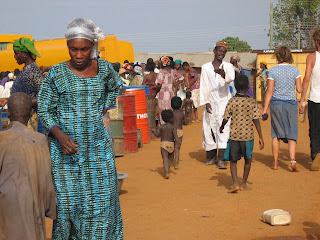
Today's post is about something I take for granted more than anything else: water. It's so easy in the west to simply turn on a tap and drink straight from it. In Ghana, I had to get used to drinking only purified water-- not too much of a trial. When I was at New Life, they did not yet have running water, though it came while I was there. For the first few months, water was hauled every day from wells by the children. It was not entirely clean, and one of the children had an ulcer on his leg from it. That was the first time I really thought about water beyond something to drink, wash with, and play in. It was life.
Then I traveled to the hot, arid north. In the village of Larabanga, as I was being shown the village, I saw a deep wash-- completely dry-- covered in deep holes. We descended into it, and I discovered that in the rainy season, it was a large pond. Now, in the dry season, it was a dust bowl. Many of the men in the village went out every day to dig and dig until they managed to get a few feet of filthy water. Water was something I had never even thought of as a necessity-- it was just there. Suddenly, I was facing an entire village so desperate for every drop, they spent their days to gain such a meager bucket of muddy water. And they were grateful for it.
While I was there, I happened to see one of the sporadic arrivals of a government water truck. The village went mad. They brought barrels, buckets, anything that could hold water and formed a mob around the truck, desperate for the absolute necessity they were deprived of. A well was in the process of being built for the village, but for the moment, that water truck and the muddy water from the wash were all they had. Water was life-- and lack of it was death.
As the article linked above mentions, even in the metropolis of Accra, water is sometimes hard to come by. Damaged water works are a big problem, and many days, people went without running water. Lack of water for farmers means drought, and therefore less food. This increases prices of goods, upping inflation, a big problem in Ghana at the moment. Water is the absolute basis of life, it affects so many things, and yet so many people live without it. Here are a few places you can go to help: http://www.idrinkbecauseicare.blogspot.com/ and http://www.waterwellsforafrica.com/.
The Return
The directors are back, and the trip was a great success! All of the legal processes were completed to begin the school, and construction should be starting any day now! The directors were also lucky enough to meet Mr. Kingsley Eshun, who has started an orphanage near the Buduburam Refugee Camp. Luckyhill Children's Home was begun in 2001, and serves around 80 children, plus 300 that come to school! Mr. Kingsley has done amazing work, much of it with his own hands, to provide all that he can for the children there. They are still in need of much support, though they are getting help from several different avenues. We have hopes that we can continue our work with Mr. Kingsley and Luckhill!
Tuesday, March 11, 2008
And They're Off!
FFCI's directors, Katherine and Blaine, are now in Ghana! After the scare with Blaine's health prior to their January trip, we weren't sure if they'd be able to make it, but they are now in Ghana and starting our school! I can't wait to see it (even partially finished) when we go over this summer.
In addition, I'd like to wish a belated Happy Independence Day to Ghana! March 6th was Ghana's 51st independence day, and to celebrate, the volunteers heading over this summer had a little party. Just a little fried plantain, Fanta, high life music, and a prep for Ghanaian culture, but it was fun!
We also have heard from one of our contacts that we will (most likely) be receiving a donation of 200 children's literacy books! This is very exciting for us-- we are building a school, after all!
I'll post more once the directors return on the developments-- and it's past time for another IAAC post. It's a busy time around here, but I'll get to it!
In the meantime, here's a pic to enjoy, since I haven't posted one in a while!

This is Prince, one of the students from my class at New Life in 05. He came into school from the village halfway through the school year. He spoke no English (though he liberally made up for it by chattering in Fante all through class), and it was a challenge just to get him to trace a line. However, he slowly improved (especially in school manners!) and was a playful, happy student and child. One of his favorite things was to "sew" cardboard pictures with string and hear me try to help him in Fante. "Ha? [Here?]" he would ask, pointing to a little hole in the cardboard. "Oho, ha [No, here]," I would respond, indicating the right hole. He would laugh in delight every time, occasionally calling to his classmates, "Bruni, wotse Fante! [The white lady is speaking Fante!]"
Wednesday, February 27, 2008
A Possible Partnership in the Works!
Today, the founders of FFCI and I met with Enterprise Mentors, a local microcredit group. I have struggled for months to set up a meeting with them. I feel that helping families develop through training and loans can be a great way to strike at the root of the orphan and needy child problem, and the founders agree. In addition, I made Michael a promise-- one that I feel extends to all the children at New Life and elsewhere-- to help his mother and his family so they can live a fulfilled life. So Michael can keep going to school. So he can eat. So he can live with his mother instead of at the orphanage.
The meeting had taken so long to set up, I had become discouraged and thought there was little interest on the EM side. Imagine my surprise and excitement when they were thrilled at the prospect of working with us in Ghana! Plans for a small office at our school and an exploratory initial program have already been discussed! After our founders return from Ghana (they leave next week!), hopefully the plans will become real. We are all so excited about the help this can bring to our children, their families, and children and families all over Ghana. EM is a well-established microcredit group, and they focus as much on training as they do on loans. We are pleased to be forming a connection with them!
The meeting had taken so long to set up, I had become discouraged and thought there was little interest on the EM side. Imagine my surprise and excitement when they were thrilled at the prospect of working with us in Ghana! Plans for a small office at our school and an exploratory initial program have already been discussed! After our founders return from Ghana (they leave next week!), hopefully the plans will become real. We are all so excited about the help this can bring to our children, their families, and children and families all over Ghana. EM is a well-established microcredit group, and they focus as much on training as they do on loans. We are pleased to be forming a connection with them!
Saturday, February 23, 2008
Square Foot Gardening
So I just got back from training on square foot (or meter) gardening, and I just have to say that it is SO COOL!!
First, a giant thank you has to go to Karen Bastow, one of the key people involved with SFG in my area, for being willing to give us free training. She traveled so far out of her way to give of her time and knowledge and we are so grateful!
These gardening techniques are truly incredible. You can create an amazing garden in 20% of the space you would use in a traditional row garden. The use of composted soil gives healthier crops and a higher crop yield. It uses significantly less water than traditional gardens, and takes a fraction of the time to care for, since the method means almost no weeds. We were shown examples of SFG's in Kenya-- some that didn't work, and why, and some that were amazing successes. One small orphanage was able to stop buying vegetables completely, and were hoping to start another garden for food they could sell!
SFG was introduced at New Life last year, but due to various factors, has not done well since. We hope that in our groups this summer we can use new materials to train them, and truly get them involved! We hope to do the same for Sankofa, and for FFCI once we get established. If the people can get the concept and really do it, I am confident that it can help provide for the children. It's not meant to compete with farmers, but to work alongside them and to help bring more food to those who are in need of it. With our two groups going back to back, it hopefully gives us enough time to see how invested they are in the project, and to ensure that it can work. We are very excited! If you have any questions about SFG, check out their website above, or email me.
Saturday, February 9, 2008
Issues Affecting African Children #4: Abandonment, Exploitation and Slavery
Today's article comes from Guinea, but it is a problem that, like the others, affects children across the continent. I highly recommend reading it for more details on the specific crisis in Guinea.
The issues of child abandonment, exploitation and slavery are not new, and can take many forms. Child soldiers, sex slaves, indentured house servants, fisherman's "helpers"...the list could go on. Some parents actually sell their children, while others believe they are giving up their children to a better life. Some children are simply taken from the streets when they're forced there after parents die. Others run away from their own slavery and end up on the streets-- just another form of slavery as they are forced into prostitution and theft.
So much of this issue stems from poverty and lack of education. Poverty itself is a form of slavery. However, simply blaming the issue on the broad term "poverty" just doesn't cut it. While the ones who do condemn children to such a situation may be desperate, deliberately placing a child in a situation that brings death, disease, hard labor, psychological trauma, and a complete lack of freedom is vile.
One organization that is trying to help through education is Free the Children. To learn more about them, the situation, and to get involved, visit their site!
Subscribe to:
Posts (Atom)

 Posts


